Research-Grade
Nutrition Tracking
2 seconds per meal. 2 minutes per week. 93% accurate. Learns your recipes.
Manual Logging Is Killing Your Progress
Over half quit within a month in clinical trials — in real-world apps, it's over 90%.
Turner-McGrievy et al. 2019, J Acad Nutr Diet; Payne et al. 2022, Obesity Sci & Practice; Industry data via Business of Apps
Manual logging takes forever
15-23 minutes per day searching databases, adjusting portions, double-checking totals.
Harvey et al. 2019, Obesity
Generic databases are inaccurate
Generic food databases don't know your portions or recipes. ~62% caloric error on homemade meals.
Urban et al. 2016, JAND
No learning, no improvement
Same tedious process on day 100 as day 1. The app never learns your recipes, your portions, or your habits.
Eatomate was built to fix all three.
How It Actually Works: 2 Minutes Per Week
Not magic. Just physics, statistics, and network effects.
You Can't Eat What You Didn't Buy
This simple physics constraint is what makes 93% accuracy possible
How It Works:
- 1.You buy 1L of milk (barcode scan = 100% accurate)
- 2.You log 4 coffees this week (quick taps, might be ±10% off)
- 3.Milk expires → System knows: 1L went into those 4 coffees
- 4.Backward reconciliation fixes all 4 coffee entries retroactively
Why This Changes Everything:
Other apps rely on your memory and guesswork forever. Eatomate uses mass conservation physics: consumed = purchased − remaining − waste.
Ingredients don't vanish — they go into meals. When the milk expires, we know exactly how much you consumed.
The longer you use it, the smarter it gets. Your recipes are learned automatically from your actual ingredient usage patterns.
3 Weigh-Ins Per Meal Item Type
Weigh your chicken breast 3 times. Your curry 3 times. Your oatmeal 3 times. System learns your typical portion and how much it naturally varies.
Chicken breast: 195g, 210g, 200g
→ Mean: 202g ± 8g
✓ Calibrated forever
90% of Meals: 1 Second
Open app → See top 5 predicted meals → Tap "Healthy Vegan Bowl" → Done. System applies your calibrated 280g ± 10g portion automatically.
• 90%: Single tap (1 sec)
• 9%: Quick search (10 sec)
• 1%: Weigh novel item (30 sec)
= 2 sec/meal
Expiry-Based Physics
Milk expires in 7 days → System auto-reconciles all meals with milk → Learns your actual usage → 93% accuracy without manual work.
• Receipt scan: 15 sec
• 28 meals × 2 sec: 56 sec
• Reweigh 5 staples: 60 sec
= 131 sec (2.2 min)
Competitors: 2+ hours/week • Eatomate: 2 min/week
Save 100+ hours per year. That's over two work weeks of your life back.
Based on Harvey et al. 2019, Obesity (15–23 min/day vs. 2 min/week)
Why It Works This Way
The engineering story behind 2 minutes per week
Before settling on what Eatomate is today, I tried everything. 3D reconstruction from photos using COLMAP. Depth-based scanning. Fine-tuned AI vision models trained on food images. Neural Radiance Fields (NeRF) to build detailed 3D food models from 2D photos. 3D Gaussian Splatting. I even seriously considered acoustic spectroscopy using a smartphone speaker — before coming to my senses. And yes, at one particularly desperate 2 AM, I genuinely explored analysing heat distortion patterns in steam rising from food to infer its contents. That one I'm not proud of. Each approach was more technically impressive than the last.
Every single one was less accurate than a £10 kitchen scale. Not slightly less — significantly less. The fundamental problem with visual estimation is that density varies wildly. A bowl of rice and a bowl of risotto look identical to a camera. Volume tells you almost nothing about mass, and mass is what your body actually processes.
So I stopped trying to be clever. A kitchen scale gives you ground truth in grams. Mass conservation physics means when your milk carton empties, the system knows exactly how much went into every meal that week. Simple inputs. Rigorous maths. That's why it works.
Sometimes the answer lies in simplicity.
The Complete Intelligence System
Track, understand, and act — powered by one receipt scan
Spend Intelligence
Snap a photo of your grocery receipt. Auto-populated pantry in 15 seconds with full cost-per-nutrient analytics and store comparisons.
What You Get:
- ✓Auto-populated pantry from grocery receipts
- ✓Cost-per-nutrient intelligence (£/gram protein, £/100 kcal)
- ✓Store comparisons and category-level spend trends
- ✓Network effects: 99%+ auto-match by month 3
Exercise Intelligence
Close the energy balance loop with MET-based exercise tracking — the gold standard for exercise physiology research.
The Science:
- ✓MET formula: (MET − 1) × bodyweight (kg) × duration (hours)
- ✓Energy balance: ΔBody Composition = Energyin - (BMR + NEAT + TEF + EAT)
- ✓Glycogen decomposition: Separate fat loss from water weight
- ✓Navy method: Repeatable body composition tracking
Meal Planner
Turn your tracking data into action. Meal plans built around what you already have in your pantry, your budget, and your nutrition targets.
How It Works:
- ✓Pantry-first recipes: Use what you have before buying more
- ✓Nutrition targets: Plans that hit your macro and micro goals
- ✓Smart grocery lists: Only buy what the plan actually needs
- ✓Budget-conscious: Spend intelligence informs cost-efficient choices
How Eatomate Is Different
93% Accuracy Through Physics
Physics-based reconciliation eliminates systematic errors. Weekly nutrition reports reach 93% accuracy (2σ).
Learn about our accuracy system →Learns Your Recipes
Not generic database approximations. Learns your grandmother's sambar (8.5g oil/100ml, not generic 3g). Your bolognese (12g oil/100g, not generic 5g). Your cooking style.
Reconciliation learns ingredient ratios unique to your household automatically.
Track All Food Spending
Receipt scan captures price + nutrition simultaneously. Groceries, restaurants, meal delivery—all food spending tracked automatically. See cost per gram of protein across everything you eat.
Learn about spend insights →Gets Smarter Every Week
Calibration learns your portions. Physics corrects your logs retroactively. Network effects speed up receipt matching. Closed-loop validation creates a precision model of your metabolism. 93%+ accuracy by Week 4.
See the learning timeline →What You Get From Every Meal Log
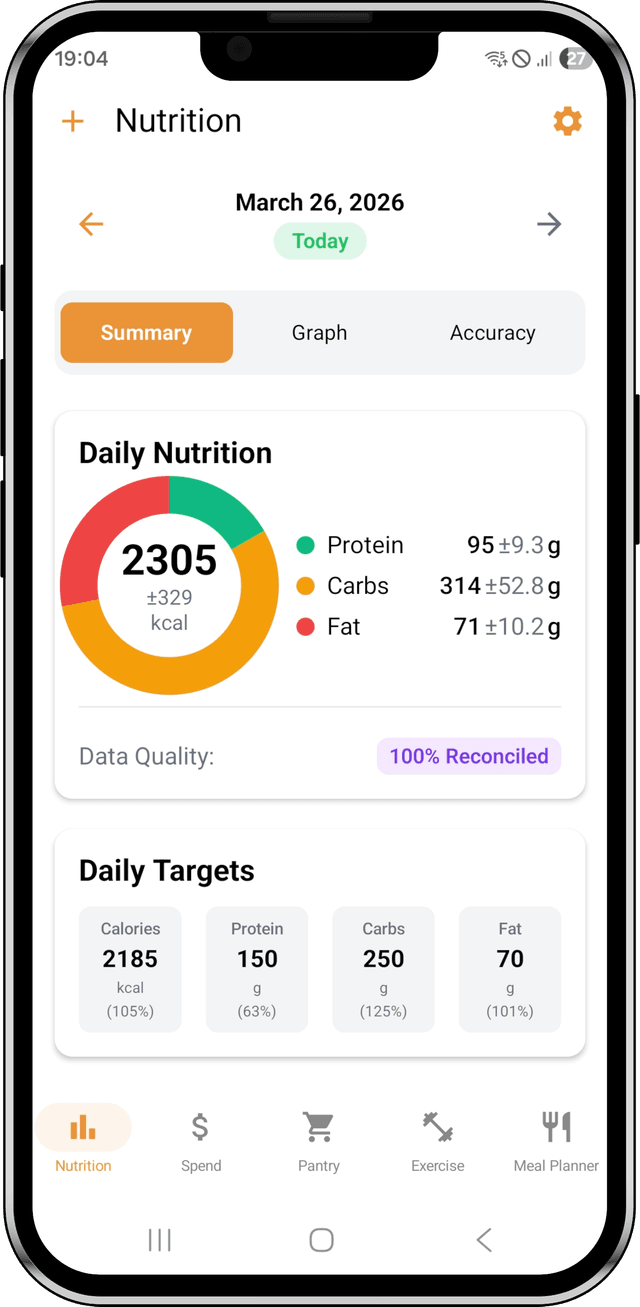
Each 2-second meal log gives you complete nutritional data
Instant Meal Data
- Meal weight in grams
Precise portion size for every meal
- Total calories (kcal)
Accurate calorie count for this exact meal
- Macronutrients breakdown
Protein, carbs, and fat in grams
- Micronutrients & vitamins
Vitamin A, C, D, B12, calcium, iron, and more
- 100% meal identity confirmation
Accurate identification of exactly what you're eating
Available Tracking Tools
- Daily nutrition tracking
See daily totals for calories and all nutrients
- Complete meal history
Full timeline of all meals with nutrition data
- Track all food spending
Groceries, restaurants, delivery—cost per nutrient across everything
- Personalized recipe learning
System learns your cooking patterns over time
- Accuracy improvement tracking
Watch your accuracy rise to 93%+ in 4 weeks
- Goal setting & progress
Set nutrition targets and track against daily goals
Backed by Science
Research-grade accuracy through scientifically validated methodology
93% Accuracy vs reality in 4 weeks
Week 1-2: Weigh 3 portions per meal type to calibrate. Week 3+: Single-tap your meal from top 5 predictions (90% of meals, 2 seconds average). Physics learns your recipes through pantry reconciliation.
Assumes ≤18% of weekly calories from ready meals and ≤10% from restaurants (Scenario B: modern household). Includes brand variation and database errors. Based on Monte Carlo simulation.
Why 93% Accuracy Matters
When tracking errors eat into your deficit, the difference between 82% and 93% accuracy isn't just 11 percentage points—it's the difference between losing 4 lbs and 10+ lbs over 12 weeks.
Without Reconciliation (82%):
500 kcal deficit → 140 kcal actual
(72% lost to errors)
With Reconciliation (93%):
500 kcal deficit → 360 kcal actual
(Only 28% lost to errors)
Weekly accuracy (2σ) after 4 weeks using mass conservation physics
Barcodes preloaded for instant nutrition lookup
Recipes covering global cuisines
Eatomate uses physics-based reconciliation—a novel approach to nutrition tracking that eliminates systematic errors.
See how Eatomate works →Your Data, Architecturally Protected
Privacy isn't a policy we follow. It's how the system is built. Unsafe uses of your data are technically impossible — not just against the rules.
No Identity in Analytics
Your name, email, and personal details are structurally absent from the analytics system — not anonymised, not masked, not present.
Two Separate Systems
Your personal data and population analytics live in completely separate systems with no join path between them — not even we can link them.
Aggregates Only
Every external query returns population statistics — means, medians, distributions. No individual record is ever exposed or queryable.
We publish how we protect your data — what we collect, what we don't, and the architectural guarantees that make misuse impossible by design.
Read our privacy whitepaper →Start Tracking the Right Way
2 seconds per meal. 2 minutes per week. 93% accurate.
Start your free 30-day trial today.
No credit card required. Cancel anytime.