How Eatomate Works
Calibrate once → Single-tap forever — 2 seconds per meal
3 weigh-ins per meal type. Then 93% weekly accuracy through auto-logging and physics.
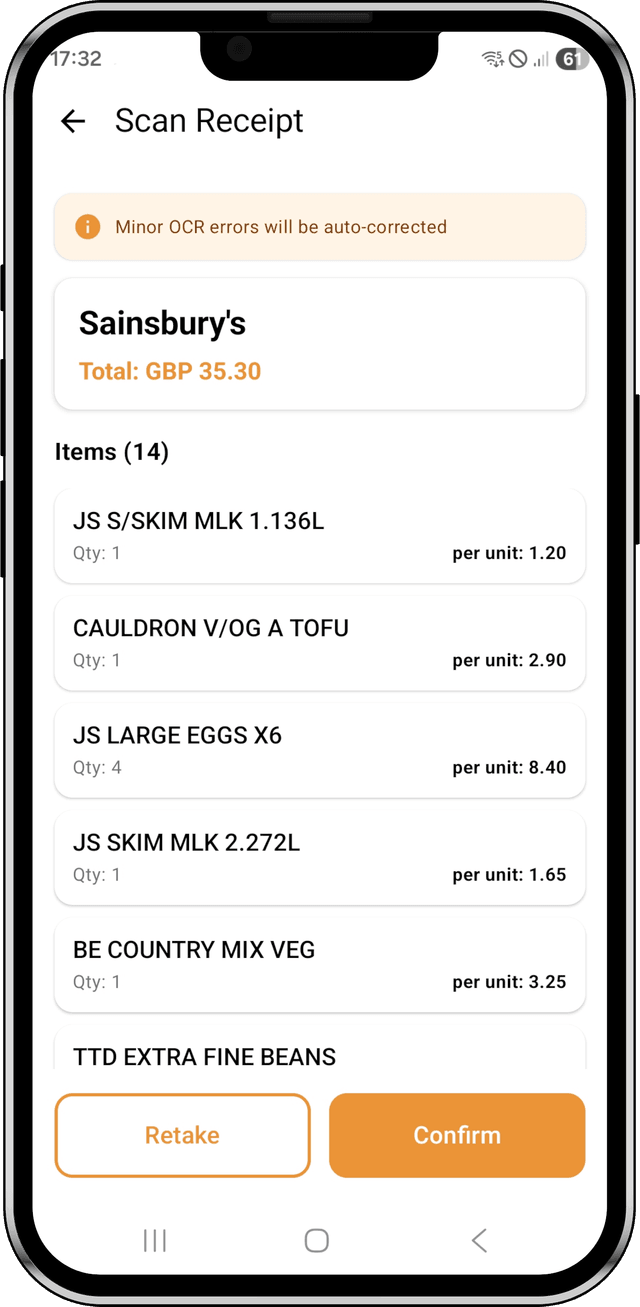
Receipt Scan → 15 Second Pantry Loading
Snap a photo of your grocery receipt. Smart text matching searches our shared mapping database and 2M+ barcode library to auto-map line items to pantry items. Two forces work together: your own shopping repetition (most households buy the same 50-80 items weekly, each mapped once and saved globally) and network effects (every mapping any user confirms helps everyone). By Month 3: 99%+ automatic match rate.
- Week 1: ~3 minutes per receipt
Worst case: 0% of line items pre-mapped. Confirm or correct each one — every mapping is saved globally and helps all users.
- Week 4: ~1 minute per receipt
~70% of items already mapped from your previous shops and other users — only new items need confirmation.
- Month 3: ~15 seconds per receipt
99%+ auto-match — your shopping repetition and mappings from other users mean virtually everything is pre-mapped. Snap and done.
When any user maps "TESCO MLK ORG 2L" → "Tesco Organic Whole Milk 2L (barcode: 5000119073525)", that mapping is saved globally. The next person who scans the same receipt item gets instant auto-match. Smart text matching handles OCR errors automatically (e.g., "TESC0" matches "TESCO", "0RG" matches "ORG").
3 Weigh-Ins Per Meal Item Type
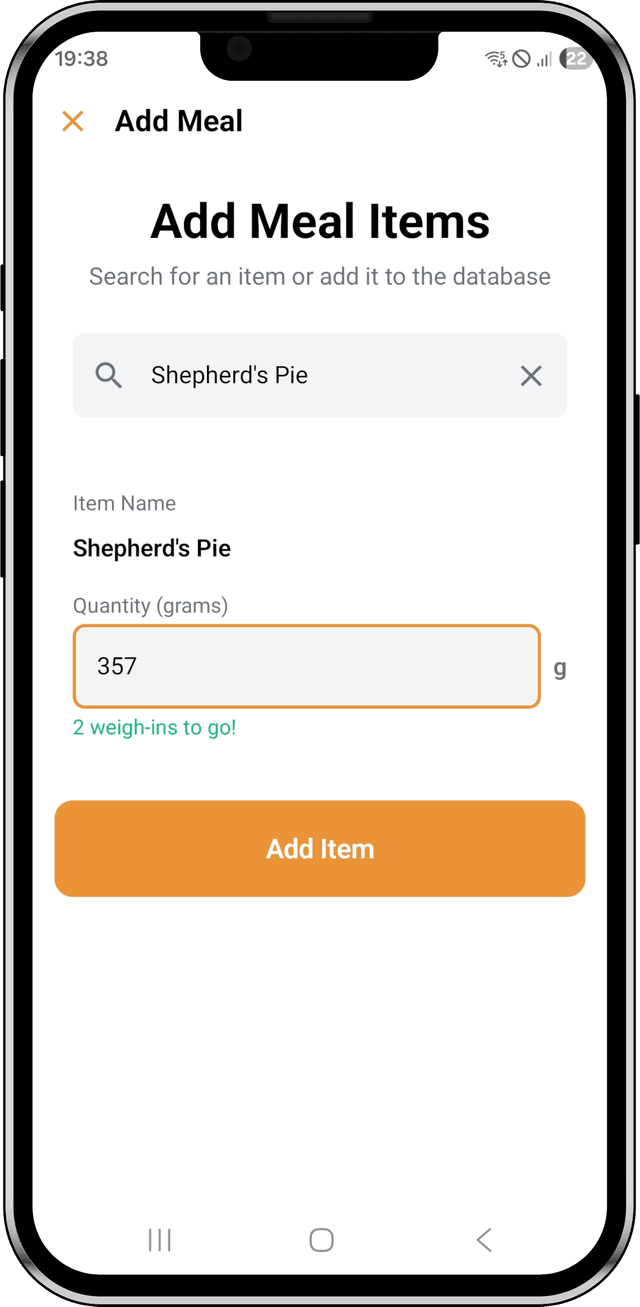
Weigh your shepherd's pie on any kitchen scale 3 times over 1-2 weeks (any basic £10 scale works). Your curry 3 times. Your oatmeal 3 times. The system learns your typical portion and how much it naturally varies. Then you're done weighing that meal forever.
- Day 1: Weigh your shepherd's pie (340g)
Search "shepherd's pie" → Weigh on scale → Enter 340g → Done
- Repeat 2 more times (357g, 325g)
System learns: Your shepherd's pie portions are 341g ± 26g (2σ)
- Calibrated! Never weigh shepherd's pie again.
System applies 341g ± 26g (2σ) automatically when you tap "Shepherd's Pie" in future meals
When you log "Shepherd's Pie," the system links it to your pantry ingredients (minced beef, potatoes, carrots, etc.). When those ingredients deplete or expire, mass conservation physics corrects your historical portion estimates to ground truth. This is how calibration + reconciliation achieves 93% accuracy.
90% of Meals: 1 Tap, 2 Seconds
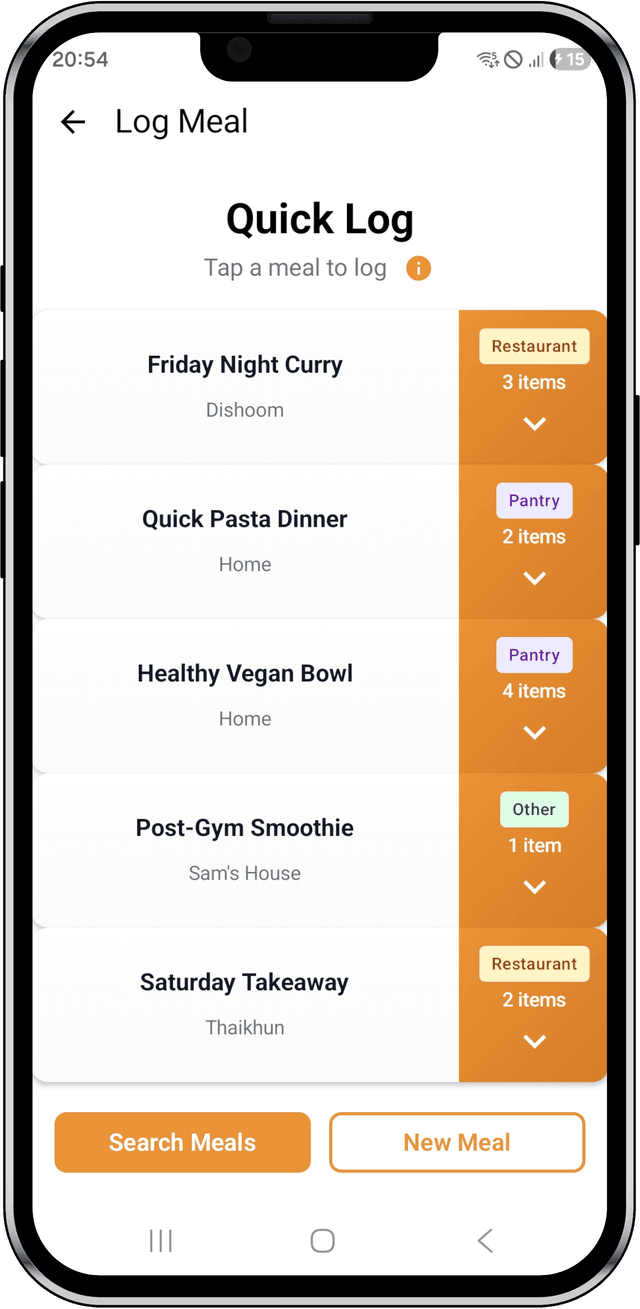
After calibration, the app predicts your top 5 likely meals based on time of day, eating history, pantry inventory, and preferences. 90% of the time, your meal is in that list. The app positions the highest-probability option exactly where your thumb rests. Just tap it.
- 90%: Single tap (1 second)
Open app → See "Healthy Vegan Bowl" in top 5 → Tap it → System applies your calibrated 280g ± 10g portion → Done
- 9%: Quick search (10 seconds)
Not in top 5? Type "pasta" → Select from results → Auto-applies your calibrated portion → Done
- 1%: Weigh novel item (30 seconds)
Trying sushi for first time? Weigh it → Enter weight → System starts learning for next time
(90% × 1 sec) + (9% × 10 sec) + (1% × 30 sec) = 2 sec average
Reconcile & Learn
When you finish a pantry item (milk carton, rice bag), we use mass conservation physics to lock historical data at research-grade accuracy (~93% by Week 4). All measurements track weight in grams with confidence intervals.
You calibrate at the meal item level (e.g. chicken curry) — reconciliation works at the ingredient level underneath. Note: “chicken curry” and “rice” are separate meal items.
- Expiry-based reconciliation
Barcode scan records purchase → Storage location determines expiry date → When expired, system reconciles all meals using that ingredient.
- Barcode nutrition becomes ground truth
Mass conservation equation distributes consumed quantities (in grams) across your meals. Multiple measurements reduce uncertainty over time — learning your cooking patterns automatically.
- System learns your recipes
Your bolognese uses 12g oil/100g (not generic 5g). Your curry uses 8.5g oil/100ml (not generic 3g). Learned automatically through reconciliation.
RECONCILIATION
PAST WEEKS
FUTURE PREDICTIONS
How We Achieve 93%+ Weekly Accuracy
Think of it like this: If you eat 2,000 calories per day (14,000 per week), we're within ±980 calories of your true intake 95% of the time. That's the difference between gaining/losing weight successfully versus wondering why your diet isn't working.
The secret? We combine three mathematical techniques:
- •Physics-based reconciliation — When you finish a milk carton, we work backwards to lock in exactly how much you consumed
- •Errors cancel out over time — Small random variations in individual meals average out across a week, giving tight confidence intervals on your weekly totals
- •Restaurant meal limits — Keep restaurant meals to ≤2 per week (they're harder to track accurately)
Includes worked examples, statistical methodology, and comparison to doubly labeled water (the gold standard research method)
Staple Maintenance
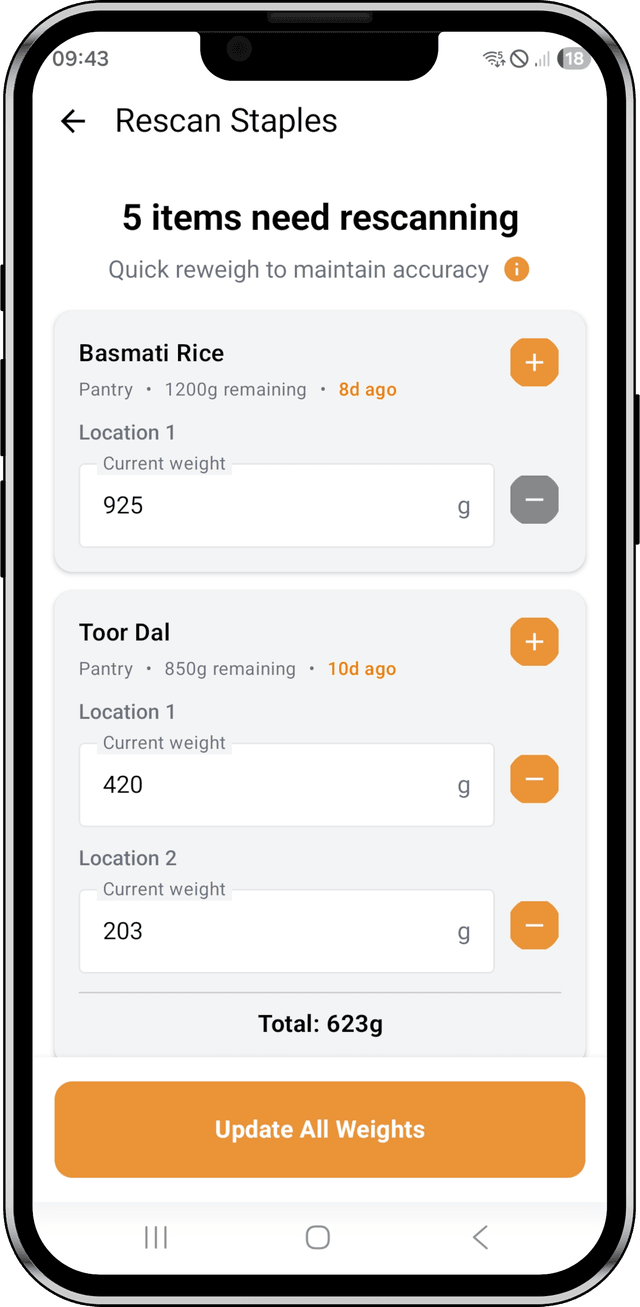
Staples (rice, dal, flour, pasta, oils, eggs, canned goods) don't expire quickly, so they need periodic rescanning to maintain accuracy. The system prompts you to rescan if consumed by more than a fixed number of calories.
- Dedicated Rescan Screen
"Scan Receipt" button shows "Reweigh X items" when staples need rescanning
- Quick Rescan (60 sec/week)
Tap button → Weigh staples (typically 3-10 items) → Done. Updates remaining quantity for accurate tracking and meal predictions.
- Multi-Location Inventory
Track opened vs. unopened containers across locations—half a bag of rice in the cupboard, full one in the pantry. Mass conservation stays accurate even when stocking up.
- Easy Accuracy Wins
No tracking every meal ingredient—just quick weekly checks for long-life staples
Receipt scan (15 sec) + Meal logging (56 sec) + Staple rescan (60 sec) = 2.2 minutes total
Why Not Use Traditional Apps?
Traditional Apps
- ✗15-23 minutes per day
1.75-2.7 hours per week. Endless scrolling. Never improves.
Harvey et al. 2019, Obesity
- ✗75-85% accurate at best
Even trained, motivated users underreport by 12-22%
Zhang et al. 2021, Advances in Nutrition; Subar et al. 2015, Am J Epidemiol (IDATA)
- ✗Generic recipes
Not your cooking style
- ✗No learning
Same tedious process forever
Eatomate
- ✓2 minutes per week (60× faster)
2 sec per meal after calibration. Single-tap 90% of the time.
- ✓93% accurate by Week 4
Physics-based reconciliation
- ✓Learns your recipes
Your grandmother's curry, not generic database
- ✓Gets smarter every week
Continuous improvement through reconciliation
For Technical Users
Deep dive into the algorithms and methodologies powering Eatomate
Receipt OCR Matching▼
Receipt printers create predictable errors. We use research-backed confusion matrices that understand certain character pairs are commonly confused by OCR. This includes both single-character substitutions and multi-character segmentation errors where two characters are misread as one (or vice versa). Each confusion has a likelihood score.
Instead of treating all typos equally (standard Levenshtein distance), we weight matches by how likely the OCR error is. A common confusion costs less than a rare one, leading to better matches on real-world receipt data.
When you map a receipt item to a barcode once, the system remembers it with a confidence score. Repeated mappings increase confidence. The cache learns your shopping patterns at specific stores. By week 12, automated matching handles 99% of receipt items.
Food Matching Engine▼
Your search text is matched against three databases (Barcode Database 2M+, Recipe Database 50K+, Alternative Names 100K+). If no exact match exists, Mistral AI generates a personalised recipe with full nutrition data, added to the database automatically.
Each food item has multiple aliases (e.g., "Shepherd's Pie" → ["Cottage Pie", "Mince and Potato Pie", "Meat and Tatties", ...]). Your search text is matched against ALL aliases in our 50K+ recipe database, ensuring you find the right item even with different naming conventions.
When no match is found (>80% confidence threshold), Mistral AI generates a complete recipe with:
- Ingredient list with quantities and classes
- Full nutrition profile per 100g
- Confidence scoring and usage tracking
Reconciliation Engine▼
When you finish an ingredient (milk carton empty), we use the equation: consumed = initial + purchased - waste - final. All quantities tracked in grams with uncertainty (e.g., 250g ± 15g). Gaussian error propagation combines uncertainties mathematically, locking historical meals at high accuracy.
Your real recipe differs from the database in many small, independent ways (different brands, oil amounts, cooking methods). CLT justifies modelling recipe-level error as Gaussian (~30% CV at 2σ per meal). Across a typical week's ~6-8 independent meal groups summing to 14,000 kcal, quadrature (root-sum-of-squares) reduces pre-reconciliation weekly error to ~18% at 2σ (~82% accuracy). Physics-based reconciliation then eliminates portion-size error and corrects recipe variance, achieving ~7% weekly error at 2σ (93% accuracy) by Week 4.
System learns your ingredient ratios automatically using weight (grams), not volume. Your bolognese might use 12g oil/100g while the generic database says 5g/100g. Reconciliation discovers this and updates recipe accuracy using exponential moving average with α=0.3 learning rate. Weight-based tracking eliminates density ambiguity (ml→g conversion errors).
Statistical Rigor: 95% Confidence Intervals▼
All displayed values include 2 standard deviation (2σ) error bars, representing 95% confidence intervals. This means we're 95% confident the true value lies within the shown range. For example, "250g ± 15g" means we're 95% certain the actual portion was between 235g and 265g.
Unlike other apps that show false precision ("exactly 247.3 calories"), we show honest uncertainty ranges. Early weeks have wider error bars (±15-20%) which narrow over time (±7% by Week 4) as the system learns your specific patterns and recipes.
The doubly labeled water method — the gold standard for measuring free-living energy expenditure — has a precision of 2-8% CV (1σ), equivalent to ±4-16% at 2σ (Schoeller, 1988). Eatomate's reconciled weekly accuracy of ±7% at 2σ is comparable to or better than this laboratory standard — achieved passively, at home, with a £10 kitchen scale.
These are high-level methodologies. Specific implementations, parameters, and optimizations are proprietary.
Ready to Track Nutrition the Right Way?
Start your free 30-day trial and experience research-grade tracking today.
No credit card required. Cancel anytime.